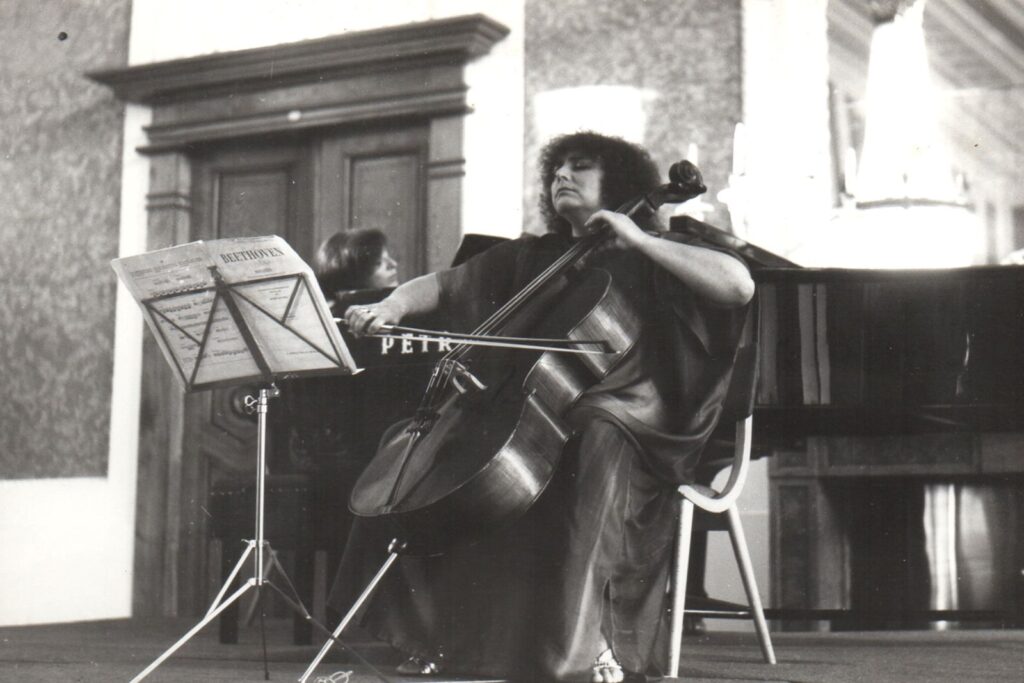
A conversation with Barbara Marcinkowska, cellist and professor at the Versailles Conservatory.
How did it happen that, during a thriving career in Poland, you suddenly disappeared from the scene and moved to France? After all, you were a renowned solo cellist, concertmaster of the Polish Radio Orchestra, member of the Warsaw Trio, and an artist performing on numerous stages?
My move to France was actually a result of a series of coincidences. After several years of professional activity, I reached a point where something needed to change. My growing “artistic anxiety” told me that I still needed to work on my own development, that my studies at the Academy of Music in Warsaw with the excellent cellist Professor Arnold Rezler and my promising concert career would all contribute to becoming a “liberated musician.”
“I initially traveled to Siena at my own expense to attend a master class with the great cellist André Navarra. There, I found myself among 70 cellists from around the world, and after a challenging exam, I was accepted onto the course. It was also there, quite by chance, that I met the Polish composer Alexander Tansman, who confirmed my resolve.
“My fascination with Navarra, a great artist and teacher, made me start working on the cello from scratch: playing on open strings, correcting my hand, and so on. Every string player knows what that means. In Siena, Barbara Marcinkowska felt like I was being reborn. Then I received a scholarship to study with Navarra at the Paris Conservatoire. I became a student for the second time.”
“In Paris, I absorbed everything related to music and art: I went to concerts, art exhibitions, and honed my French. Paris is the perfect place in this regard.” There, I was finally able to develop my interest in painting, which I had harbored since childhood. Alongside my work on the cello, I began studying painting. I believed, and still believe, that painting is very helpful to a musician. After all, painterly color is close to musical color. Paul Klee is my master painter, and as we know, he was also a violinist. There’s a lot of music in his painting: rhythm, color, form. It leads to a synthesis of the arts. I believe painting has broadened my means of musical expression. Now, I think, I can play the cello “painterly.”
So you studied cello and painting in Paris. But I heard you also defended your doctoral thesis at the Sorbonne?
– My studies at the Sorbonne and my doctoral thesis are a consequence of my fascination with Navarra’s cello and pedagogical art. Navarra was perhaps the greatest French cellist. He created a modern cello style and a pedagogical system, if you can call it that. I had to, I felt the need, to put down on paper what Navarra taught. He left no written trace behind him, yet he educated hundreds of students who are now among the world’s leading artists.
What specifically was your dissertation at the Sorbonne about?
– It’s titled: “André Navarra – a great interpreter of the cellist, the pinnacle of pedagogy in France.” The thesis is divided into two parts. The first part is: In addition to providing a synthetic historical background, I explain Navarra’s pedagogy and bowing technique. Secondly, I discuss interpretative issues and Navarra’s musical propositions. I heard that a “restless spirit” even compelled you to practice yoga?
– Yes, I practiced yoga to understand the body. After all, when playing the cello, the musician’s body must also play. In a sense, playing an instrument is physical labor. The harmony of the body’s movements influences the harmony of the music. Of course, I’m speaking very simplistically, but the point is clear.
You are a concert artist, performing as a soloist and chamber musician, and also dedicate yourself to teaching…
– I don’t complain about a lack of classes. I give premieres of contemporary works. I have performed with great success, among others, excellent works by Piotr Moss, a Polish composer who settled in Paris, and by French composers. I was drawn to teaching by the outstanding violinist Ivry Gitlis, with whom I lead summer master classes at the Camerata de Rouen. My frequent performances with the Versaille ensemble led to my receiving a professorship at the Versailles Conservatory, one of the oldest conservatories in France. I am the only non-French teacher in the history of the university.
Finally, let me add that you record albums for various labels and your concert schedule for the coming period is packed with performances in Spain, Germany, and France. Thank you for the interview.
Artykuł SŁOWO DZIENNIK KATOLICKI 19-20-21 marca 1993 r.
Notował STANISŁAW DYBOWSKI